No superpower will save Bangladesh – Only its people can, says Lord Rami Ranger
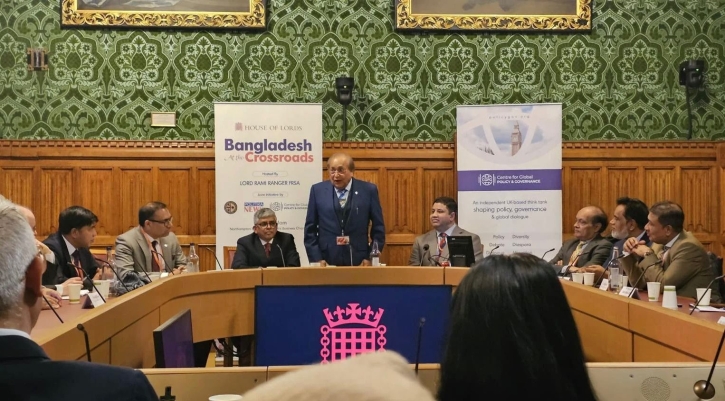
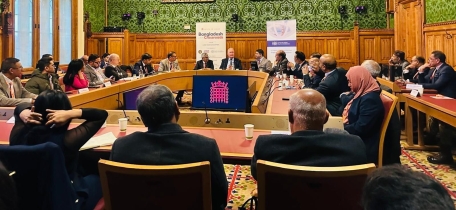
A warning against political division, religious extremism and reliance on foreign powers dominated a House of Lords seminar on Bangladesh’s future, hosted by Lord Rami Ranger.
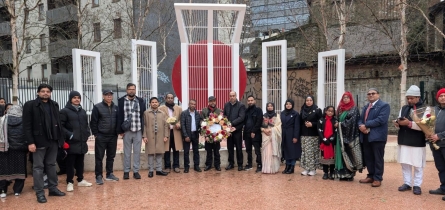
The event, titled “Bangladesh at the Crossroads”, was held in a Committee Room of the House of Lords on 28 January 2026 and jointly organised by Politika News, the Centre for Global Policy and Governance, and the Northampton British Bangladeshi Business Chamber. The seminar was formally welcomed by Councillor Naz Islam of Northampton Town Council and presided over by Lord Rami Ranger. A cross-party discussion and interactive Q&A session followed, moderated by Tanvir Ahmed, Editor-in-Chief of Politika News. The keynote address was delivered by Barrister Sonjoy Kumar Roy, Co-Founder of the Centre for Global Policy and Governance.
Delivering a deeply personal and wide-ranging speech, Lord Rami Ranger urged Bangladesh to pursue a future grounded in secular democracy, tolerance, respect for diversity and the rule of law. “No superpower will save a nation from within,” Lord Ranger said. “Only its people, its values, and its vision can.” He warned against political polarisation, the misuse of religion, and an over-reliance on external alliances, arguing that global powers act primarily out of strategic interest rather than loyalty. Lord Ranger praised the Bangladeshi diaspora in the United Kingdom for its resilience, work ethic and contribution to British society, saying the community played a vital role in inspiring future generations through education, visibility and leadership. Referring to Britain’s success as a multicultural society, he said progress was built on equality before the law, respect for faith and the protection of minorities.
He also stressed that national development could not be achieved without empowering citizens, particularly women, through education, opportunity and good governance. Expressing concern over what he described as the erosion of respect for Bangladesh’s historical legacy, he appealed to community leaders and the diaspora to engage constructively in safeguarding the country’s democratic foundations.
Robert John Blackman CBE MP, Member of Parliament for Harrow East, attended the seminar as a special guest and reflected on the long-standing relationship between the United Kingdom and Bangladesh. He recalled Britain’s support during Bangladesh’s 1971 War of Independence under Prime Minister Edward Heath and noted that Bangladesh’s founding leader made one of his earliest international visits to the UK. Turning to Bangladesh’s current political situation, Mr Blackman said that while international attention had focused on protests and the deaths of students during the previous government’s tenure, developments following the change in government had raised serious concerns about democratic stability.
“The credibility of any election depends on participation, inclusivity and public confidence,” he said. He added that opinion polling suggested a significant proportion of the Bangladeshi population continued to support political parties currently unable to participate freely in the electoral process.
“If political parties are prevented from standing in elections, democracy itself is placed under question,” Mr Blackman warned, adding that bans, boycotts or exclusions ultimately weaken representative governance. He also expressed concern about reports of a proposed referendum that could fundamentally alter Bangladesh’s constitutional direction, warning that intimidation or coercion of voters would be incompatible with democratic norms and could have lasting consequences for the country’s stability. On human rights, Mr Blackman said documented attacks against religious and minority communities, including Hindus, Christians and minority Muslim groups, were deeply troubling.
“These are not social media fabrications,” he said. “They are documented cases involving real victims, including killings, arson, and the destruction of homes and places of worship.”
He urged members of the Bangladeshi diaspora in the UK to engage actively with their local MPs. He called for stronger scrutiny and a more proactive response from the Foreign, Commonwealth & Development Office.
The seminar featured contributions from a wide range of speakers, including Anwar Choudhury, former British diplomat; Shahagir Bakth Faruk MSc, Adviser Emeritus of the British Bangladeshi Chamber of Commerce & Industry; Osama Khan, Vice-Chancellor of the University of South Wales; Nadira Naznin Rakhi, DPhil student at the University of Oxford; M A Rouf, Trustee of the Northampton Bangladeshi Association; Dr Zaki Rezwana Anwar, Child Health Specialist; Mitu Choudhury, Secretary General of the Bangladesh Caterers Association (UK); Bashir Ahmed BEM, former President of the British Bangladeshi Chamber of Commerce & Industry; Professor Dr Sanawar Choudhury, CEO of RCI Accountancy; Professor Dr Habib-e-Millat, President of the Global Centre for Democratic Governance; Aminul Haque, former Bangladeshi diplomat; Md Razib Parvez, Founder of the Governance Policy Explore Centre; Haradhan Bhowmik, former President of the Sarbojanin Baba Lokenath Association (UK); Barristers Moinul Islam Monju and Michael Murphy; Ameena Tabassum, Author and Data Professional; Harmuz Ali, President of the Bangladesh Welfare Association; Ansar Ahmed Ullah, Journalist; Shofa Miah, Director of Newham Voices and Ashok’s Vision; Md Zakir Hussain, Director of Community Careline Medway Ltd; Adity Roy, Choreographer; and Syed Ali Ziru, Barrister and Human Rights Lawyer.
The event concluded with calls for greater unity within the Bangladeshi community and renewed commitment to democratic values both at home and within the diaspora